I moved to the Netherlands in September 2000. That’s a long time ago and staying abroad this long is no mean feat, even if I do say so myself. But it hasn’t always been an easy road to travel. Nobody told me about culture shock.
These days I struggle with my identity on an almost daily basis – I’m stuck somewhere in the middle between learning to be Dutch and naturally being British. It’s a different struggle than the one I faced when I first moved here.
I lost my job in England and decided the time was right for a change. When my then boyfriend said come live a Dutch life with me I didn’t hesitate. I stopped my job search, sold my flat and packed up all my belongings in a borrowed police trailer. Easy peasy. I became an immigrant – just like that.
Did I stop to think about what I was heading to? Did I stop to imagine what life in the Netherlands as a Brit would be like?
Of course I did. The decision to move wasn’t made on a whim, and I knew there would be some adjustments on my part. I had a new language to learn (which I started doing as soon as I met my Dutch partner) and I had a job to find in a country where I didn’t speak the language. We also had to find somewhere to live together for the long term. I knew I would miss my family and friends. A lot. A heartachingly lot.
When I look back, that’s quite a lot to do and a lot of change to go through in the space of a few months. I see that now, but then it was just a list of things to get sorted to get our Dutch life together on track. I went abroad with my eyes open. But I didn’t see the whole picture.
What I didn’t think about was the constant feeling of not being able to make yourself wholly understood wherever you went. I didn’t know there was such a gap between ‘speaking Dutch’ and ‘speaking Dutch to a level which meant natives let you speak Dutch’.
I had no idea I would feel so humiliated every time I asked for something as simple as a stamp in Dutch and get an answer back in English. I didn’t know it would be years before that stopped happening, before I reached the “congratulations, your Dutch is at a reasonable enough level for me to actually respond in Dutch to you” level.
I hadn’t thought about the every day, normal life challenges that I would face – like doing grocery shopping. Knowing that varkensvlees is pork is the easy part, knowing what cut of meat you are buying and what you are supposed to do with it when you get it home is something else indeed. I never dreamed I would face that moment in the supermarket when you think you may actually have just picked up meat from the fridge that was destined for a dog bowl, and not for human consumption.
I didn’t know how many tears I would shed whilst watching the BBC because it reminded me of a home I no longer had, but had not yet recreated on the other side of the North Sea.
I had no idea how many times I would utter “you’d never see this in England’ or “why can’t the Dutch just do it like the English?” and that even the little things would frustrate me.
I had given no thought to how it would feel to have nothing familiar around me: Roads were different; shops were different; houses were different; voices were foreign and unrecognisable to my ears; there were suddenly bikes everywhere; there were canals everywhere I looked. Everything was different. Much of it was beautiful, but still different.
I hadn’t considered how far out of my comfort zone I would be thrown. I wasn’t even in the same country as my comfort zone.
I could never have known that the urge to give it all up in the Netherlands and head back to England would at times be overwhelming, that it would take everything I had not to run back.
I hadn’t thought about the fact that moving in with the future mother and sister-in-law after living alone in my own place may well be difficult, no matter how lovely they were to me or how amazingly kind it was that they gave me a temporary home and made me feel welcome. It’s always hard to take a step backwards.
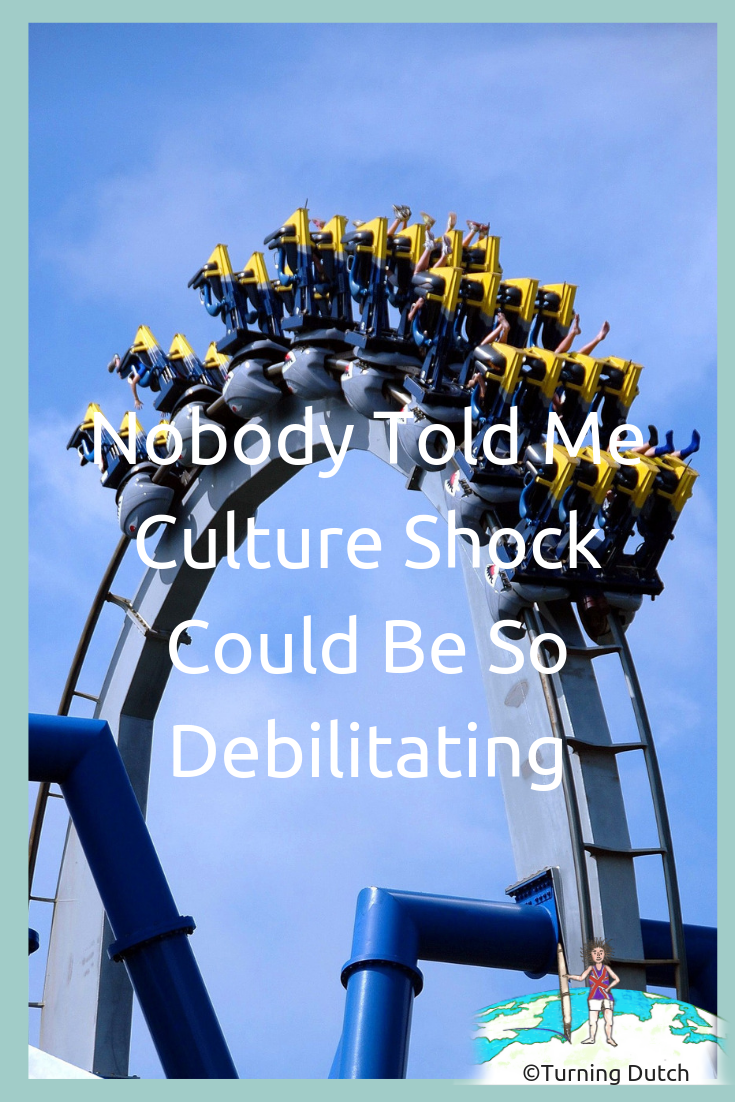
I did not know that expat life meant taking a seat, getting strapped in and heading off on an emotional rollercoaster that doesn’t just turn your entire life upside down, but which makes you violently scream at someone to let you off, that makes you scratch desperately at the safety belt which automatically closed around your neck, that safety harness which no one has the power to release until the ride is over and you have come to a grinding halt.
I wasn’t told about the tears I would shed. I hadn’t realised I would be fearful about what the future held for me. I didn’t know I would doubt every move I had made on the way to this new ‘home’.
No one told me I would go through culture shock. Nobody warned me that it is an inevitable part of expat life. Nobody told me it would be debilitating. Nobody told me it would pass. No one thought to mention I would come through it, I would clamber my way through the culture shock tunnel and eventually see light.
Nobody mentioned that one day my only struggle with expat life would be sitting in a place between learning to be Dutch and naturally being British. Nobody said that one day I would smile when the passport controller welcomed me home at Schiphol.
Nobody told me that the Netherlands would one day truly feel like home.
Nobody told me. So I’m telling you. You will get through it. It will pass. And you will thrive on the other side. It’s the bad part you have to go through to get to the best part of expat life, to get to the happy side of expat life.
Culture shock is part of the expat journey, it’s not a destination.


33 comments